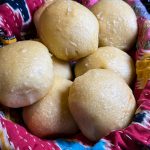
Overnight Vegan Sourdough Dinner Rolls (With Same-Day Option)
Servings: 12
Calories: 149kcal
Soft and fluffy vegan sourdough dinner rolls made with soy milk and vegan butter. Shape and refrigerate overnight, then finish proofing and bake the next day for fresh, warm rolls when you’re ready to serve. A same-day option is also included when time allows.
Print Recipe
Equipment
- 9-by-13-inch metal baking pan
Ingredients
- 115 grams sourdough starter active and bubbly
- 240 grams unsweetened soy milk warmed
- 2 Tablespoons vegan butter melted
- 3 Tablespoons granulated sugar
- 360 grams bread flour plus a small amount only if absolutely necessary
- 1 teaspoon fine salt
- Additional vegan butter for greasing the pan and brushing the baked rolls
- sea salt flakes for finishing optional
Instructions
Day One
- Prepare your active bubbly sourdough starter (I use 1:3:3 ratio. It takes several hours so plan accordingly.)
- Warm the soy milk to approximately 85–95°F. If it becomes warmer, let it cool before adding the starter. Melt the vegan butter240 grams unsweetened soy milk, 2 Tablespoons vegan butter
- Stir the melted vegan butter and sugar into the warm soy milk.3 Tablespoons granulated sugar
- Add the active sourdough starter and stir until mostly combined.115 grams sourdough starter
- Add 360 grams of bread flour, then sprinkle the salt over the flour.360 grams bread flour, 1 teaspoon fine salt
- Mix until no dry flour remains. The dough will initially be sticky and shaggy. Do not immediately add more flour.
- Cover and let the dough rest for 1 hour.
- Complete three sets of stretch-and-folds, spacing the sets approximately 30 minutes apart. With damp hands, stretch one side of the dough upward and fold it over itself. Rotate the bowl and repeat on all four sides.
- After the third set of stretch and folds, cover the dough and let it continue fermenting. Begin checking it after 1 hour. It may need approximately 1–2 hours after the final stretch-and-fold, depending on the room temperature and starter strength.
- Check the dough. The dough is ready when it has risen approximately 50–75%, looks rounded and aerated, and has visible bubbles along the sides or underneath. It does not have to double or become extremely jiggly.
- Generously grease a 9-by-13-inch metal baking pan with vegan butter.
- Shape each portion into a ball by pulling the edges underneath and pinching the seam closed. Arrange the rolls seam-side down in the prepared pan. (Weigh the entire dough and divide that number by 12. Each portion should weigh approximately 65–66 grams. See the blog post for visual instructions.)
- Cover the pan tightly and refrigerate immediately for 12–18 hours. The tested batch was refrigerated for approximately 15 hours.
Day Two
- Remove the covered pan from the refrigerator approximately 2–3 hours before baking.
- Keep the rolls covered while they warm and finish proofing. Begin checking after 2 hours.
- The rolls are ready when they look noticeably larger, rounded, and pillowy. Some may be touching or nearly touching, although spacing in the pan can affect this.
- Gently press one roll about ¼ inch with a lightly floured finger. The indentation should slowly rise while remaining faintly visible. If it springs back immediately, allow another 20–30 minutes.
- Preheat the oven to 375°F while the rolls finish proofing.
- Bake for approximately 18–22 minutes, beginning the temperature check at 18 minutes. The tops may only become lightly golden.
- Remove the rolls when a center roll reaches approximately 195–200°F internally. Do not continue baking solely to achieve a darker top.
- Brush the hot rolls with melted vegan butter.
- Cool in the pan for 5–10 minutes, then transfer to a cooling rack.
For Same Day Option
- Follow the Day One directions above but don't put them in the refrigerator. After shaping, cover the rolls and let them proof at room temperature until pillowy and visibly expanded, approximately 2–3 hours. Begin checking before the 2-hour mark because a warm kitchen or very active starter can shorten the proof considerably. Bake as directed above.
Notes
- Use an active starter. The starter should be bubbly, expanded, and at or near its peak before mixing the dough. If I have enough time, I like to prepare a 1:3:3 ratio for my starter.
- Watch the milk temperature. Warm the soy milk to about 85–95°F. Milk that feels hot can damage the natural yeast in the starter.
- Expect sticky dough. The dough will be sticky and shaggy when first mixed. Give the flour time to hydrate during the one-hour rest before deciding whether it needs additional flour. Add more only if the dough remains unmanageably wet after resting.
- Follow the dough, not only the clock. Sourdough timing varies with room temperature, starter strength, and refrigerator temperature. During bulk fermentation, look for a 50–75% increase in volume, a rounded appearance, and visible bubbles.
- Check bulk fermentation early. Begin checking within 1 hour after the final stretch-and-fold. In a warm kitchen, the dough may be ready within 1–2 hours.
- Overnight timing: The shaped rolls can be refrigerated for approximately 12–18 hours. This recipe was tested with a cold proof of about 15 hours.
- Avoid an unnecessarily long cold proof. Refrigeration slows fermentation but does not stop it. Extended fermentation can eventually weaken the gluten, leaving the rolls overly sour, sticky, slack, or unable to hold their shape.
- Plan for a room-temperature proof. After refrigeration, the rolls will generally need 2–3 hours to warm and finish rising. Begin checking at 2 hours.
- Same-day option: Skip refrigeration after shaping and let the covered rolls rise at room temperature until pillowy, generally 2–3 hours. Begin checking before the 2-hour mark in a warm kitchen.
- Use visual proofing cues. Properly proofed rolls should look larger, rounded, soft, and pillowy. They may not all touch if they were spaced farther apart. the gentle poke test. A shallow indentation should slowly rise while remaining faintly visible. A mark that springs back immediately indicates that the rolls need more time.
- Do not wait for deeply browned tops. These vegan rolls may remain only lightly golden. Begin checking at 18 minutes and use an internal temperature of 195–200°F as the best indicator of doneness.
- Best enjoyed fresh. These rolls are at their softest on the day they are baked. Store cooled leftovers airtight at room temperature and gently reheat before serving the following day. They are not recommended for three-day storage.
Nutrition
Serving: 1roll | Calories: 149kcal | Carbohydrates: 27g | Protein: 4g | Fat: 2g | Saturated Fat: 1g | Polyunsaturated Fat: 1g | Monounsaturated Fat: 1g | Trans Fat: 0.01g | Sodium: 217mg | Potassium: 55mg | Fiber: 1g | Sugar: 3g | Vitamin A: 131IU | Calcium: 29mg | Iron: 0.4mg